Illinois Extension Says Put Your Leaves to Work: The Bag, Depth, and Compost-Ratio Math
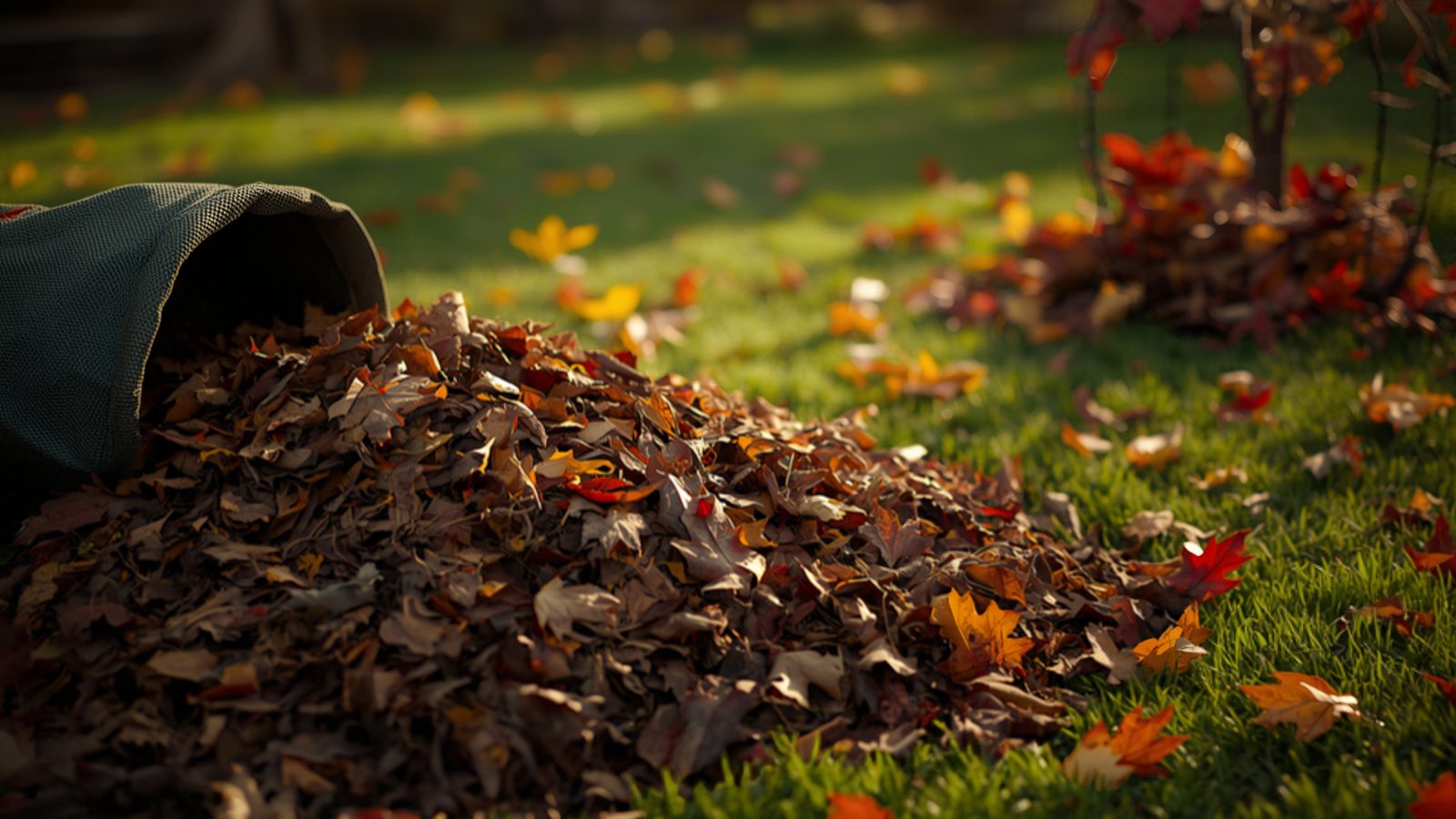
Leaf season has started across much of the country, and University of Illinois Extension horticulture educator Ken Johnson used his October 16 Good Growing column to make a familiar but worthwhile case: stop treating fallen leaves as trash. His list of better uses is short. Mow them into the lawn. Work them into garden beds. Shred them for mulch. Pile them around tender perennials as winter insulation. Compost them. Leave some alone as winter shelter for insects, toads, and salamanders. His reasoning is that trees spent all summer pulling nutrients out of your soil, and the leaves are how you get those nutrients back.
The column gives one number: a lawn with only 10 to 20 percent leaf cover can be left as is. It doesn't say how many leaves each of the other jobs uses, which is the question that decides what you do with the pile. A typical yard produces more leaves than any one use can absorb, so the useful plan is a split: some on the lawn, some on the beds, some in the compost, and the rest stored. Here is the math for each part.
The Unit That Makes This Easy: One Bag
Most people measure leaves in bags, so use the bag as your unit. A standard 39-gallon lawn and leaf bag holds 39 × 0.134 = about 5.2 cubic feet. Everything below converts back to that number.
The second number you need is your own shredding ratio, meaning how many bags of whole leaves turn into one bag of chopped ones. It varies a lot with leaf type, how dry the leaves are, and your mower, so don't use someone else's figure. Rake one full bag of whole leaves onto the driveway, run the mower over it with the bagger on, and see how much of a bag you get back. If one full bag shreds down to a fifth of a bag, your ratio is 5 to 1. We use 5 to 1 in the examples below. Swap in your own.
Job One: The Lawn
Johnson's threshold is the easy part: at 10 to 20 percent cover, leave the leaves where they are. To estimate cover, stand at ten spots spread across the lawn and look straight down at about a square foot of ground. Count how many spots are mostly leaf. Two out of ten is 20 percent. Above that, mow when the leaves are dry, and stop when you can see grass through the chopped leaves. New York's Department of Environmental Conservation puts the limit at three-quarters of an inch of shredded leaves on a lawn. Anything past that goes to the next job.
Job Two: Mulching the Beds
Johnson says to shred leaves before using them as mulch, because whole leaves mat into a layer that sheds water. For depth, New York DEC advises keeping total mulch at three inches or less and away from trunks and stems.
The volume formula is square feet × depth in inches ÷ 12. A 4-by-8-foot bed at 3 inches takes 32 × 3 ÷ 12 = 8 cubic feet, which is 8 ÷ 5.2, or about 1.5 bags of shredded leaves. At a 5-to-1 ratio, that is roughly 7 to 8 bags of whole leaves raked off the lawn for one bed. Four beds take about 30 bags. That is usually the first point where the math shows you have more leaves than you thought, or fewer.
Size the Mulch Layer for Every Bed
Enter each bed's length, width, and target depth in the Mulch Calculator to get cubic feet, then divide by 5.2 to get bags of shredded leaves.
Open the Mulch Calculator →Mulching beds for this? Compare wheelbarrow, bow rake, and landscape fabric on Amazon.
GardeningMath may earn a commission from qualifying purchases made through affiliate links, at no additional cost to you.
If you refilled dry subsoil this fall (see our subsoil recharge math), a leaf mulch layer is also what keeps that water from evaporating over winter. For other bed shapes, our mulch calculation guide covers circles and odd layouts.
Job Three: Winter Insulation Cages
For borderline-hardy plants like figs, lavender, and some hybrid tea roses, Johnson suggests piling shredded leaves around the crown or filling a wire cage with them. The goal is to keep the plant evenly cold instead of letting it freeze and thaw repeatedly. Wait to do this until temperatures stay below freezing. Packing leaves around a plant too early mostly gives it a warm, damp place to rot.
A round cage is a cylinder, so its volume is π × radius² × height. A cage 3 feet across and 3 feet tall holds 3.14 × 1.5 × 1.5 × 3 = about 21 cubic feet, or about 4 bags of shredded leaves. Shredded leaves settle, so budget a fifth bag to top it up after the first few weeks.
Job Four: Composting
This is where the math matters most, because leaves are mostly carbon. Cornell's composting program puts autumn leaves at 30 to 80 parts carbon per part nitrogen. It also says composting works best near 30 to 1. A bin of leaves alone will sit there for a very long time. Cornell's yard waste fact sheet gives two ways to balance them: add one part grass clippings to three parts leaves, or 2 pounds of nitrogen per cubic yard of leaves.
The fertilizer option takes one conversion. A cubic yard is 27 cubic feet, or about 5.2 bags. With a fertilizer labeled 21-0-0, 2 ÷ 0.21 = about 9.5 pounds of product per cubic yard, or roughly 1.8 pounds per bag of leaves. For any other product, divide 2 by the first number on the label (as a decimal).
Kitchen scraps are where most home bins come up short. Using carbon and nitrogen values from a backyard compost recipe by Cornell's Tom Richard (leaves at 50 percent carbon and 0.75 percent nitrogen, food scraps at 42 percent and 5 percent, both on a dry-weight basis), reaching 30 to 1 takes about 0.25 pounds of dry scraps per pound of dry leaves. Leaves in that recipe are 35 percent water and scraps are 80 percent water, so in wet weight that is about 0.8 pounds of fresh scraps for every pound of leaves. A household that throws out 5 pounds of scraps a week can balance only about 6 pounds of leaves a week. That is a small fraction of one fall's leaf drop.
The fix is not more scraps. It is storage. Keep most of your shredded leaves dry, in bags or a wire bin, and add them to the compost a bucket at a time all year as greens come in, including next summer's grass clippings at the 1-to-3 ratio.
Job Five: Leave Some Alone
Johnson's last point needs no math. Leave a corner, or the leaf litter under shrubs, undisturbed until spring. Overwintering butterflies, native bees, and amphibians use that layer. If you are tidying beds after the first frost, set aside one bed to leave as it is.
Source: University of Illinois Extension — Ken Johnson, "Put your leaves to work this fall," Good Growing blog, October 16, 2026, https://extension.illinois.edu/blogs/good-growing/2026-10-16-put-your-leaves-work-fall. Lawn and mulch depth limits: New York State DEC, "What To Do With Fall Leaves," https://dec.ny.gov/get-involved/living-green/reduce-reuse-recycle-compost/what-to-do-with-fall-leaves. C:N ranges: Cornell Composting, "Compost Chemistry," https://www.css.cornell.edu/cwmi/compost/chemistry.html, and Tom Richard, "Composting Ingredients," Municipal Yard Waste Composting Fact Sheet #2, https://www.compost.css.cornell.edu/Factsheets/FS2.html. Material carbon, nitrogen, and moisture values: Magdoff and van Es, Building Soils for Better Crops, 4th ed., section 13.2. The 5-to-1 shredding ratio, bed and cage sizes, and the 5-pound weekly scrap figure are illustrative.
Quick Recap
- A 39-gallon leaf bag holds about 5.2 cubic feet. Measure your own shredding ratio with one test bag.
- Leave lawn leaves alone at 10 to 20 percent cover. Mow them in up to about 3/4 inch of shredded leaves.
- Bed mulch = square feet × inches ÷ 12. A 4-by-8 bed at 3 inches takes about 1.5 bags shredded, or 7 to 8 bags whole at 5 to 1.
- A 3-by-3-foot insulation cage holds about 21 cubic feet, or 4 bags. Fill it once temperatures stay below freezing.
- Leaves alone are too high in carbon to compost quickly. Balance them at 1 part grass to 3 parts leaves, or 2 pounds of nitrogen per cubic yard. Kitchen scraps alone can't keep up, so store the extra leaves and add them through the year.
Bagging leaves for the curb costs you the bags and the nutrients. Fifteen minutes with a tape measure tells you how many leaves your yard can actually use.