Real Christmas Tree Prices Are Holding Steady: The Stand, Water, and Ceiling Math to Make Yours Last
Christmas tree season has started, and this year the price news is mostly good. In a November 27 report, the Boston Globe found that New England growers have a healthy supply of trees and that wholesale prices are flat. Nigel Manley of the New Hampshire-Vermont Christmas Tree Association told the paper that shoppers shouldn't see a significant price rise. ABC News reported on November 24 that sellers nationally expect prices to stay about where they were last season, starting at roughly $90 a tree. The Real Christmas Tree Board says more than 90% of growers have no plans to raise wholesale prices. Where you buy still matters, though. The Globe gives the example of a $65 cut-your-own tree in northern New England that could cost $90 or more farther south, while pre-cut trees at Boston-area lots can top $200.
There's a timing catch too. A Massachusetts Christmas Tree Association spokesperson told the Globe he expects at least half of the group's farms to sell out in the first weekend after Thanksgiving. That means many trees are going up this weekend and will need to last close to four weeks, sometimes longer. A cut tree is still a plant, and the reason it stays fresh or dries out is mostly water. Here is the math to check before you buy and in the first week after.
Step One: Work Out the Tallest Tree Your Room Can Take
One grower ABC News interviewed, Ashley Ahl, said the first job is measuring your ceiling before you go out, so you don't bring home a tree that's too big for the room. The tag height isn't the number that has to fit. The stand lifts the tree, and the topper adds height on top of that:
Maximum tree height = ceiling height − stand lift − topper height − clearance
Take an 8-foot (96-inch) ceiling. If the stand holds the trunk 4 inches off the floor, your star adds 8 inches, and you want 2 inches of clearance so it doesn't scrape: 96 − 4 − 8 − 2 = 82 inches, or about 6 feet 10 inches. A tree tagged 7 feet is already a squeeze in that room, and an 8-footer won't fit at all. (These stand and topper heights are examples. Measure your own, because both vary a lot.) Write the number down and take a tape measure to the farm or lot. Trees look smaller outdoors.
Step Two: Size the Stand to the Trunk
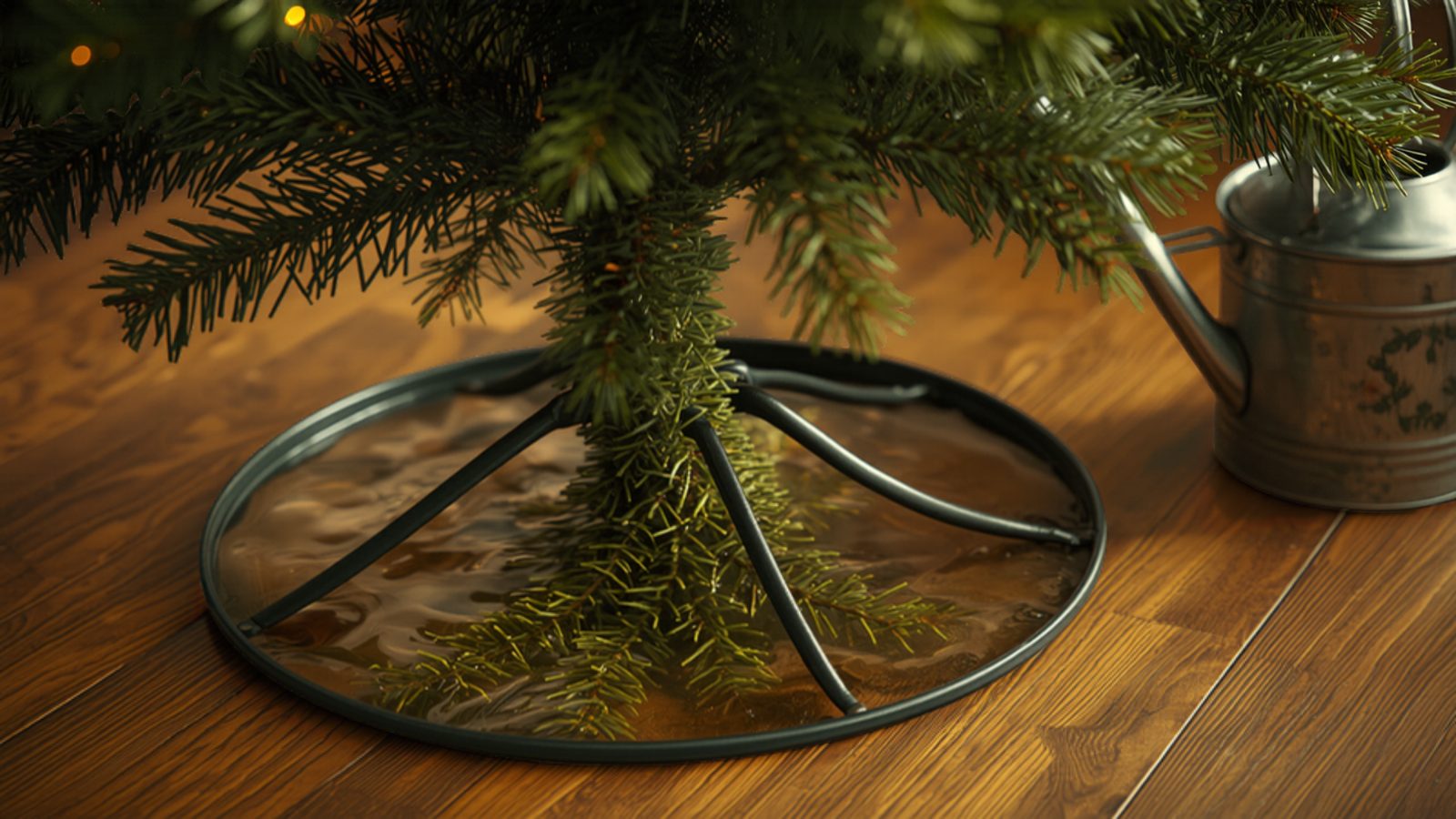
Penn State Extension, Oregon State University Extension, and University of Illinois Extension all give the same rule of thumb: the stand should hold about 1 quart of water for every inch of trunk diameter. Penn State adds that most trees need a stand holding at least 1 gallon.
Stand capacity (quarts) = trunk diameter (inches)
- 4-inch trunk: 4 quarts = 1 gallon.
- 5-inch trunk: 5 quarts = 1.25 gallons.
- 6-inch trunk: 6 quarts = 1.5 gallons, the example Oregon State uses.
Diameter is hard to measure on a trunk covered in branches, so measure around it instead and divide:
Diameter = circumference ÷ 3.14
A trunk that measures 16 inches around is about 5.1 inches across, so it needs a stand that holds at least 5 quarts. Most stands list their capacity on the box. If yours is too small, Oregon State's advice is to buy a bigger stand or a smaller tree. Penn State warns against shaving the sides of the trunk to fit a narrow ring. The outer wood carries water most efficiently, and that's the part you'd be removing.
Step Three: Count Only the Water Above the Cut
Here is the part a capacity label doesn't tell you. Penn State points out that a stand can still have water in it after the base of the trunk is no longer sitting in it. Only the water above the cut end is available to the tree:
Usable water = stand capacity − the volume below the cut end
Days between refills = usable water ÷ daily draw
Penn State and Oregon State both say a cut tree drinks a surprising amount in the first days indoors, especially in a heated house. You can't look up your own tree's thirst, but you can measure it. For the first few mornings, refill the stand to the same mark with a measuring cup and write down how much it took. Say your 1.5-gallon stand holds about 1 gallon above the cut, and you find yourself adding 3 quarts a day the first week (an illustration, not a typical figure). Then 4 quarts ÷ 3 quarts ≈ 1.3 days. In practice that means checking morning and evening, not every other day. When the daily refill falls off, you can go back to once a day. Penn State and Illinois both say to keep the water level above the base of the trunk at all times.
Planning Next Season's Watering?
Tracking how fast a tree empties its stand is the same supply-and-demand thinking behind every watering decision in the garden. The Watering Schedule calculator applies it to your beds, working out how much water and how often based on your plants and conditions.
Open the Watering Schedule Calculator →Setting up watering for this? Compare drip irrigation kit, hose timer, and soil moisture meter on Amazon.
GardeningMath may earn a commission from qualifying purchases made through affiliate links, at no additional cost to you.
Step Four: Know Your Time Limits
Most mistakes with a cut tree come down to timing, and the extension sources give actual numbers:
- Getting it into water: Ahl told ABC News the first hour or two is the window before the cut end starts to seal itself, so get the tree into water right away.
- When to recut: Penn State says no fresh cut is needed if the tree was harvested within the past 12 hours, but to recut after that. Oregon State puts the limit at 24 hours since the last cut.
- How much to cut: Penn State and Oregon State say a disk about ¼ inch thick is all you need. Illinois suggests a 1-inch cut. Either way, cut straight across. Penn State says angled or V-shaped cuts make the tree harder to hold in the stand and reduce the water available to it.
- If the stand runs dry: Oregon State says most Douglas-fir, noble, Nordmann, and Fraser firs will rehydrate if refilled within 24 hours, without taking the tree down to recut it. For grand fir, the limit may be 12 hours.
Plain water is all a tree needs. Penn State, Oregon State, and Illinois all say sugar, aspirin, bleach, and commercial preservatives don't help, and Oregon State says some additives can make needles drop faster. Water temperature doesn't matter either. What does help, according to Penn State, is keeping the tree away from fireplaces, heat vents, and direct sun, because a cooler room slows drying and cuts daily water use.
Step Five: Check the Days and the Cost per Day
Illinois Extension says many fresh-cut trees last at least five weeks before drying out if they're properly cared for. A tree that goes up Sunday, November 29 has 26 days until Christmas and 33 days until New Year's Day, both inside that window. Buying early, as many shoppers seem to be doing this year, is fine as long as the stand never runs dry.
That same five weeks makes the prices in the news easier to compare:
Cost per day = tree price ÷ days on display
- $65 cut-your-own tree ÷ 35 days ≈ $1.86 a day.
- $90 farm or lot tree ÷ 35 days ≈ $2.57 a day.
- $200 pre-cut city-lot tree ÷ 35 days ≈ $5.71 a day.
A tree that dries out and comes down after two weeks costs more than twice as much per day as the same tree kept watered for five. That makes looking after the stand worth real money. ABC News also reported, citing the American Christmas Tree Association, that artificial tree prices are up 10% to 15% over the past two seasons. If you're comparing the two, divide the artificial tree's price by the price of the real trees you usually buy. The answer is how many seasons it takes to break even, before storage and replacement.
Source: The Boston Globe — Amanda Gokee, "Christmas tree prices: What to expect in New England," November 27, 2026, https://www.bostonglobe.com/2026/11/27/metro/christmas-tree-prices-new-england/. National price outlook, grower ceiling and freshness tips, and artificial tree prices: ABC News, "Prices of real Christmas trees expected to stay steady this holiday season: Growers," November 24, 2026, https://abcnews.com/GMA/Living/prices-real-christmas-trees-expected-stay-steady-holiday/story?id=138386931. Stand capacity, minimum 1 gallon, usable water, recut timing and thickness, heat, and additives: Penn State Extension, "Caring for Your Cut Christmas Tree," https://extension.psu.edu/caring-for-your-cut-christmas-tree. 6-inch stand example, 24-hour recut and refill limits, and species notes: Oregon State University, "Treat your Christmas tree to vodka? Only if you want to waste it," https://news.oregonstate.edu/news/treat-your-christmas-tree-vodka-only-if-you-want-waste-it. 1-inch cut and five-week lifespan: University of Illinois Extension, "Caring for Live Christmas Trees," https://extension.illinois.edu/christmas-trees/caring-live-christmas-trees. The ceiling, stand lift, topper, trunk circumference, and daily draw figures are illustrative.
Quick Recap
- Prices for fresh-cut trees are mostly flat this year, but where you buy can mean anything from about $65 to over $200.
- Maximum tree height = ceiling − stand lift − topper − clearance. An 8-foot ceiling often fits a tree under 7 feet, not an 8-footer.
- The stand should hold 1 quart per inch of trunk diameter (diameter = circumference ÷ 3.14), and at least 1 gallon.
- Only water above the cut counts. Measure your daily refills for the first week to see how often to check.
- Get the tree into water within an hour or two, recut about ¼ inch straight across if it's been more than 12–24 hours, and use plain water.
- Kept watered, a tree can last five weeks, which brings a $90 tree down to about $2.57 a day.
A tape measure for the ceiling, a quick circumference check on the trunk, and a measuring cup for the first week of refills are all you need. Get those three right and this year's tree should still be holding its needles at New Year's.