Bare-Root Fruit Tree Season Starts Now: The Rootstock Spacing Math to Do Before You Buy
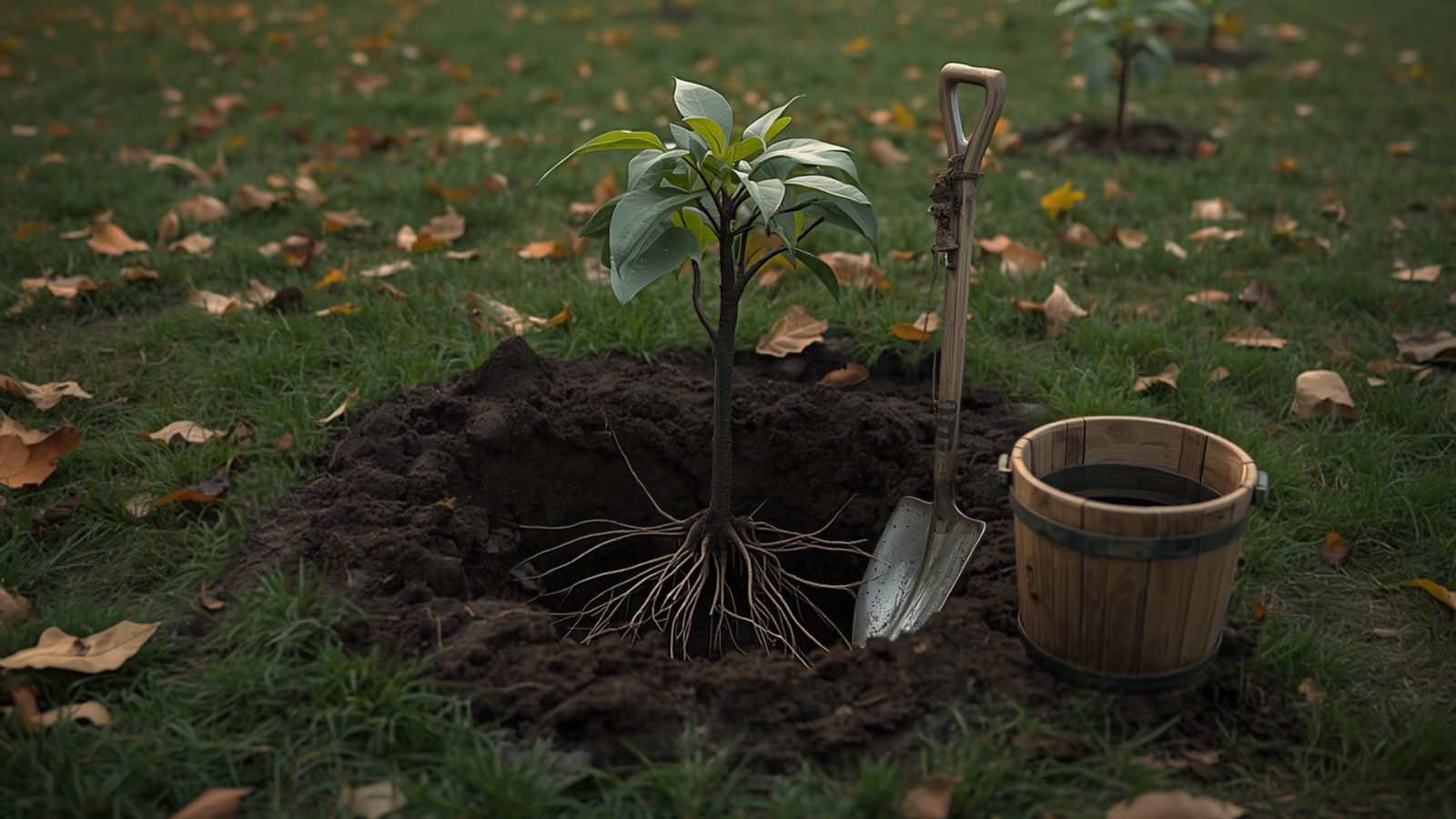
Nurseries in mild-winter regions are about to fill their bins with leafless fruit trees, roots wrapped in damp sawdust. In the November 19 edition of the Fresno County UC Master Gardeners' weekly calendar, Master Gardener Terry Lewis notes that bare-root planting season begins this month in California's Central San Joaquin Valley. The calendar also advises that when you choose a bare-root fruit tree, you should think about the rootstock, not only the variety on the tag. Frost-tender plants such as citrus and avocado are a different case: the calendar says to hold them until spring, once the danger of frost has passed.
The rootstock advice deserves more attention than it usually gets. The same 'Honeycrisp' or 'Fuji' label can sit on a tree that tops out at a size you can prune from the ground, or on one that needs a ladder and a third of your yard. Rootstock sets that size, so it sets your spacing, and spacing decides how many trees you can actually plant. That's worth working out at home, before you're standing at the bin.
Why Rootstock Is a Spacing Decision
Almost every fruit tree you buy is two plants joined together. The top (the scion) decides what fruit you get. The bottom (the rootstock) largely decides how big the tree grows. University of Illinois Extension publishes a spacing table for home fruit plantings, written as distance between trees in a row by distance between rows. For apples, the range is wide:
- Dwarfing rootstock (M.9 or Bud.9): 8 × 14 to 10 × 16 feet.
- Semi-dwarfing (M.26, or M.7 interstem): 10 × 15 to 14 × 20 feet.
- Vigorous semi-dwarf (MM.106 or MM.111): 16 × 22 to 20 × 28 feet.
- Seedling (standard) rootstock: 20 × 30 to 25 × 35 feet.
Illinois lists stone fruit separately. Peach, apricot, nectarine, and plum on seedling rootstock run 14 × 20 to 20 × 28 feet, while the same fruits on the dwarfing St. Julian A stock drop to 8 × 16 to 12 × 18 feet. The table also says to use the wider end of the range for vigorous varieties such as Red Delicious and Winesap.
Step One: Convert Spacing to Square Feet per Tree
A spacing pair is easier to compare once you multiply it out. Each tree "owns" a rectangle:
Area per tree = in-row spacing × between-row spacing
- Dwarf apple: 8 × 14 = 112 sq ft, up to 10 × 16 = 160 sq ft.
- Semi-dwarf (M.26/M.7): 10 × 15 = 150 sq ft, up to 14 × 20 = 280 sq ft.
- MM.106/MM.111: 16 × 22 = 352 sq ft, up to 20 × 28 = 560 sq ft.
- Standard apple: 20 × 30 = 600 sq ft, up to 25 × 35 = 875 sq ft.
Compare the ends of the range and one standard apple takes about as much ground as five or more dwarfs (600 ÷ 112 ≈ 5.4, and 875 ÷ 160 ≈ 5.5). That ratio matters more than any single number. In a small yard, rootstock choice is often the difference between a one-tree orchard and a five-variety one, with fruit spread over several weeks instead of arriving all at once.
Step Two: Fit the Trees to Your Actual Space
Real yards are strips along a fence or a back corner, not open fields. A simple way to count trees in a single row is to give each tree its full in-row spacing and leave half a spacing at each end:
Trees in a row = row length ÷ in-row spacing, rounded down
Take a 40-foot run along a back fence (our example):
- Dwarf apple at 8 feet: 40 ÷ 8 = 5 trees. At the wider 10 feet, 4 trees.
- Semi-dwarf at 10 feet: 4 trees. At 14 feet, 2 trees (40 ÷ 14 = 2.9, rounded down).
- MM.106 at 16 feet: 2 trees.
- Standard at 20 feet: 2 trees, and a far bigger width problem.
The width check is where people get caught. With a single row, the between-row figure tells you roughly how much clear width the row needs, about half of it on each side of the trunk line. Dwarf apples at 14 feet need about 7 feet on each side. A standard tree at 30 feet wants about 15 feet each side, which won't fit in a 20-foot-wide side yard without the canopy pushing into the fence, the house, or the neighbor's lot. If your space is narrow, the width usually rules out a rootstock before the length does.
Lay Out the Row Before You Dig
Once you have picked a rootstock and its spacing, the Plant Spacing Calculator works out how many plants fit in a bed or row of any size. Enter your fence-line length and the in-row spacing to check the count before you buy.
Open the Plant Spacing Calculator →Laying out beds for this? Compare raised garden bed, square-foot garden grid, and long tape measure on Amazon.
GardeningMath may earn a commission from qualifying purchases made through affiliate links, at no additional cost to you.
Step Three: Dig to the Graft Union, Not to the Roots
Spacing a dwarf tree correctly only works if it stays dwarf. If the graft union (the knobby bump where scion meets rootstock) ends up below the soil, the scion can send out its own roots and the tree can grow to full size. University of Maine Cooperative Extension says to set the graft union two to three inches above the ground, and Illinois Extension gives about three inches for dwarf apples. So the depth of the hole comes from the union, measured down:
Hole depth = distance from root tips to graft union − 3 inches
If the roots hang 14 inches below the union, dig about 11 inches deep and spread the roots over a small cone of soil in the bottom. For width, UMaine suggests cutting the sod in a circle about a foot wider than the root spread. Roots that spread 20 inches call for a circle about 32 inches across.
Two other UMaine numbers are worth checking before you buy. The site should have at least 18 inches of soil above any ledge or hardpan. And never put fertilizer in the planting hole. That fits the Fresno calendar's advice for the same week to check and improve drainage around plants in low areas, because a bare-root tree sitting in a soggy hole all winter is at risk before it ever leafs out. Illinois does allow a small dose at planting, 1/8 pound of a balanced fertilizer such as 10-10-10, but it's spread in a band 1 to 2 feet from the trunk, not in the hole.
Step Four: Cut the Top Back to Match the Roots
Bare-root trees lose a lot of roots when they're dug at the nursery, so the top gets shortened to match. UMaine says to cut an unbranched whip to 30 to 36 inches above the soil and to remove branches growing below 18 inches. Illinois says nursery apples, pears, cherries, and plums are typically sold at 3 to 6 feet tall. A 5-foot (60-inch) whip headed to 33 inches loses 27 inches, about 45% of its height. That feels drastic, but it's what the instructions call for.
Until you plant, keep the roots wet. Illinois says to soak them in a tub of water for no longer than 2 days, and to heel the trees in (lay them in a trench at about a 45-degree angle and cover the roots) if planting is delayed longer. After planting, UMaine recommends 2 to 5 gallons of water right away. In the growing season, give about 5 gallons a week in any week with less than an inch of rain.
A Note on Timing Outside California
The Fresno calendar's "this month" is regional. UMaine doesn't recommend fall planting in New England and favors bare-root planting in April or early May. Illinois prefers spring planting statewide, with late fall planting acceptable in southern Illinois. If your winters are cold, the same spacing math applies, but this is the season to measure the yard and order trees, not to plant them. Order with the rootstock name in hand. The UC calendar's point about rootstock hardiness applies everywhere: a rootstock that can't handle your winter undoes all the careful spacing above it.
Source: UC Master Gardeners of Fresno County, Fresno Gardening Green — Terry Lewis, "This week in the garden: Nov. 20 - 26," November 19, 2026, https://www.ucanr.edu/blog/fresno-gardening-green/article/week-garden-nov-20-26. Spacing by rootstock, graft union height for dwarf apples, soaking limit, fertilizer at planting, nursery tree heights, and Illinois timing: University of Illinois Extension, "Fruit Trees for Home Gardens: Planting," https://extension.illinois.edu/fruit-trees/planting. Graft union height, sod circle width, minimum soil depth, no fertilizer in the hole, heading height, watering, and New England timing: University of Maine Cooperative Extension, James R. Schupp, "Bulletin #2411, Planting and Early Care of Fruit Trees," https://extension.umaine.edu/publications/2411e/. The 40-foot fence line, 20-foot side yard, root lengths, and whip height are illustrative.
Quick Recap
- Rootstock, not variety, sets mature size, so it sets spacing. Ask for the rootstock name before you buy.
- Multiply in-row × between-row spacing: a dwarf apple needs about 112–160 sq ft, and a standard apple 600–875 sq ft, roughly five dwarfs' worth.
- Trees in a row = row length ÷ in-row spacing, rounded down. A 40-foot fence line holds 4–5 dwarf apples or 2 standard trees.
- Check width too: a single row needs about half the between-row spacing on each side of the trunk line.
- Keep the graft union 2–3 inches above the soil, so hole depth = root-tip-to-union length minus about 3 inches.
- Head unbranched whips to 30–36 inches, soak roots no longer than 2 days, and keep fertilizer out of the planting hole.
A tape measure along the fence and two multiplications will tell you which rootstock your yard can hold. Do that before you go to the nursery and you'll come home with a tree that fits for good.